You can read the decision here.
Yesterday, Palestine Action won their High Court challenge against the U.K. government over the groups ban as a terrorist organisation. A High Court judge ruled the ban on the group under anti-terrorism legislation was “disproportionate and unlawful” however, the group remains banned for now allowing for further legal arguments and time for the government to consider an appeal.
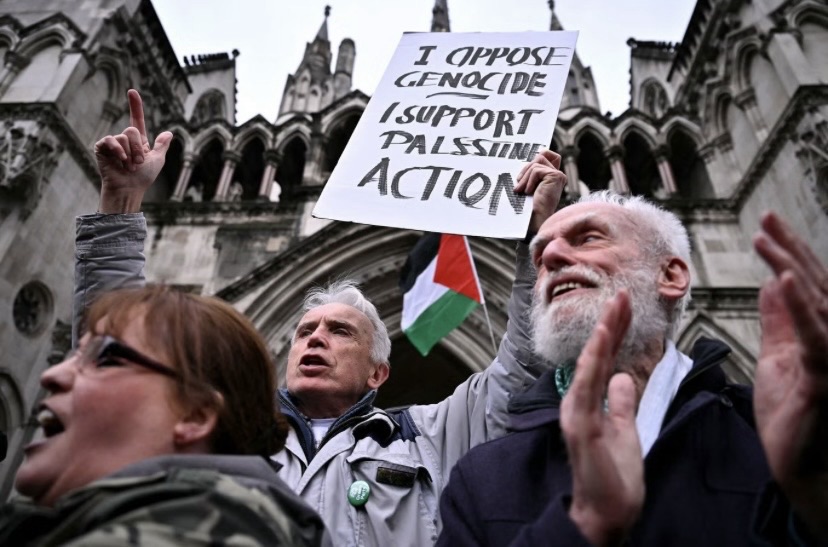
The decision comes after thousands of arrests across the U.K. for opposing the ban, often holding signs that read “I oppose genocide. I support Palestine Action,” with thousands of protestors charged under terrorism offences. A staggering 890 arrests were made on 6th September 2025 alone at a protest in London.
Palestine Action co-founder Huda Ammori stated “this is a monumental victory, both for our fundamental freedoms here in Britain and in the struggle for freedom for the Palestinian people”.
As reported by The Guardian, The Home Secretary, Shabana Mahmood, was urged to respect the court’s decision after the three judges said the ban (introduced by predecessor Yvette Cooper) impinged on the right to protest and should be quashed. Mahmood said the government would appeal against the court’s decision, asserting that she was “disappointed” by the judgment. Six activists were also recently found not guilty of aggravated burglary on 4th February 2026 over a break-in at an Israeli weapons factory in Britain.
Keir Starmer has been a human rights barrister since he got his qualifications in 1987. He was appointed QC, now KC (King’s Council) in 2002. In 2008, he became Director of Public Prosecutions for CPS… it’s safe to say he knows when to listen to the ruling of the court. Especially when it is the High Court speaking. Mahmood is a part of Starmer’s cabinet. I can’t see him going against a court ruling even just to save face, to do so, I believe, would seriously deteriorate his legal credibility. Even though he talks like a lawyer, he is not our lawyer – he is our Prime Minister, so – the questions urged are, would Keir Starmer acting in position as head of government take a different course of legal action compared to what he would do as a legal actor representing somebody else, I wonder? The only difference between the two and how he would confront a court challenge is, now he has the power of PM. Whether he will use his legal mind and take the words of the court in, or persist through the government to challenge the court and save face, will reveal a lot more about Keir Starmer than he intended.
Things that stood out to me
On page 12 of the Judiciary.uk document, (30. iv) The Home Secretary’s decision to proscribe states:
“The Home Secretary’s statement to Parliament that she had decided to proscribe Palestine Action was made, as we have said on 23 June 2025, shortly after the incident in which three Palestine Action activists broke into RAF Brize Norton and damaged two military planes with spray paint. The Home Secretary’s decision to proscribe however, which appears from the documents to have been made no later than 20 June 2025, had been under consideration since the end of 2024”.
So, 6 months or so this had been a plan in motion that was considered before being brought to the House, 6 months later.
Page 24 – (65) The Court states “the circumstances of the present case, even if only on a small scale, indicate practical obstacles to any obligation to give prior notice of proscription and seek representations on the matter”.
This seems pretty much immoveable from The Court, as Palestine Action was not given notice or representation of the proscription. Basically, no matter who the organisation is – the government has a certain set of rules to follow and obey whilst exercising proscribing powers.
113. “The submission on behalf of the Home Secretary in this case is that in circumstances where Palestine Action has been designated a terrorist organisation by the order made pursuant to her decision, any expression of support for, or association with, Palestine Action amounts to the expression of support for or association with terrorist activity, and so falls outside the scope of articles 10 and 11 by virtue of article 17”.
So, according to the rights of Palestine Action as determined in the European Convention on Human Rights (ECHR), the Home Secretary was disproportionate in applying proscription and Palestine Action has not met the requirements to be considered to be a terrorist group. The court continued,
114. “We reject this submission. The Home Secretary cannot rely on the fact of designation– the lawfulness of which is in issue – to establish that a statement, such as “I support Palestine Action”, or a wish to associate with Palestine Action, aims to destroy Convention rights and values. In Roj TV, the PKK’s designation as a terrorist
organisation, including by the European Union, was not in issue and the repeated
statements were incitement to violence. That is a very different case. Moreover, reliance on Roj TV for the contention that article 17 applies to any expression of support for a proscribed organisation is inconsistent with the judgment of the same Section in Sabuncu v Turkey (23199/17, 19 April 2021) in which it was said (at paragraph 222):
“Freedom of political debate, which is at the very core of the concept of a democratic society, also includes the free expression by prohibited organisations of their views, provided that these do not contain public incitement to commit terrorist offences, or condone the use of violence.”
115. In any event, this case is primarily concerned with the rights of individuals who have not acted unlawfully either before or since proscription, who would have wanted to express support for and associate with Palestine Action – whose stated aim is “to stop genocide and other atrocity crimes by causing disruption to corporate actors who aid, abet, facilitate and profit from those crimes” – and who wished to engage in peaceful protests under the banner of Palestine Action, but are stopped from doing so. It cannot sensibly be said that such persons are seeking to deflect the article 10 and 11 rights from their real purpose by employing them for ends contrary to Convention values. Nor could that be suggested in respect of others, such as journalists, academics and civil society
organisations who are conscientiously seeking to abide by the law, and whose rights are impacted. The Home Secretary’s article 17 submission fails”.
138. Nevertheless, we are satisfied that the decision to proscribe Palestine Action was disproportionate. At its core, Palestine Action is an organisation that promotes its political cause through criminality and encouragement of criminality. A very small number of its actions have amounted to terrorist action within the definition at section 1(1) of the 2000 Act.
140. Considering in the round the evidence available to the Home Secretary when the decision to proscribe was made, the nature and scale of Palestine Action’s activities, so far as they comprise acts of terrorism, has not yet reached the level, scale and persistence that would justify the application of the criminal law measures that are the consequence of proscription, and the very significant interference with Convention rights consequent on those measures. Finally concluding the decision with an unmistakable “the Considering in the round the evidence available to the Home Secretary when the decision to proscribe was made, the nature and scale of Palestine Action’s activities, so far as they comprise acts of terrorism, has not yet reached the level, scale and persistence that would justify the application of the criminal law measures that are the consequence of proscription, and the very significant interference with Convention rights consequent on those measures”.
What is also important here, is context.
According to The Guardian, We Believe in Israel and the Campaign Against Antisemitism were the ones who pressed the government to proscribe Palestine Action via previously revealed meetings under the Conservative government, with Elbit representatives and Israeli embassy officials, that were “apparently concerned with cracking down on the group”.
Alas, lobbying isn’t in British Politics. Or is it?


Leave a Reply